Timely Kenya's 4th Devolution Scorecard gauges county progress four years after the 2022 election, based on a CATI survey of 3,303 respondents across all 47 counties. It rates governors on water, health, social and economic empowerment, education and agriculture.
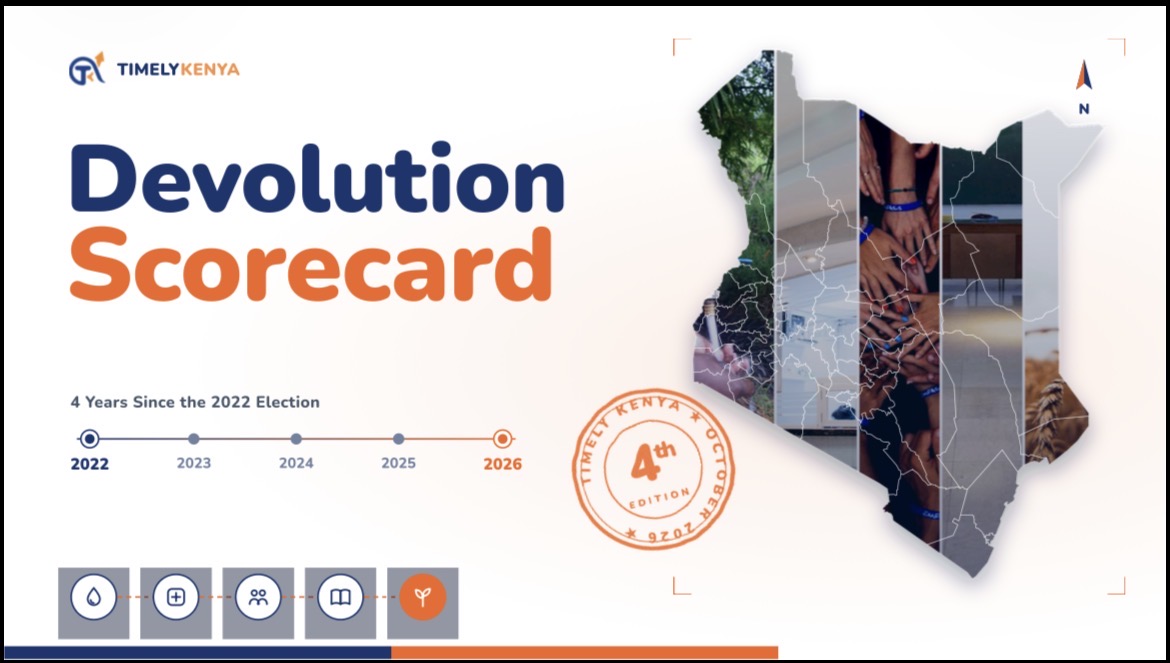
The 4th edition of the Devolution Scorecard assesses county performance on five key devolved functions: Water, Health, Social and Economic Empowerment, Education and Agriculture. Respondents rated each parameter on a scale of 1 to 10, with each point equal to 10%.
Is devolution working? 55.9% said devolution is working, 39% said it is not, 3% were not sure, 1.1% did not know and 1% did not care.
Impact vs lagging areas: County roads, agriculture, water, sports and culture, and social empowerment were cited as impact areas. Health, education and job creation were cited as lagging areas.
Health: 56.1% of respondents said health should not remain with county governments, while 37.9% said it should.
What is ailing devolution: Respondents ranked corruption first, followed by poor planning and priorities, wastage of public funds, lack of proper oversight from county assemblies, and late disbursement from the exchequer with little allocation from the National Government.
County rankings: The counties that feel devolution is working most are Murang'a, Kiambu, Machakos, Homa Bay and Bungoma. The happiest counties are West Pokot, Murang'a, Narok, Machakos and Trans Nzoia.
Governor presence: Governors seen as always on the ground are Ochilo Ayako (Migori), Wavinya Ndeti (Machakos), Jonathan Bii (Uasin Gishu), Isaac Mutuma (Meru) and Simon Kachapin (West Pokot). Those rarely seen on the ground are Abdi Ibrahim (Isiolo), Mohammed Khalif (Mandera), Simba Arati (Kisii), Issa Timamy (Lamu) and Benjamin Cheboi (Baringo).
Overall top 10 governors: